
Scheme of a solid-oxide fuel cell
A solid oxide fuel mobile phone (or SOFC) is an electrochemical conversion device that produces electricity directly from oxidizing a fire. Fire cells are characterised by their electrolyte material; the SOFC has a solid oxide or instrumentation electrolyte.
Advantages of this class of fuel cells include high conjunctive heat and power efficiency, long-term stability, fuel flexibility, low emissions, and relatively low cost. The largest disadvantage is the high operating temperature which results in yearner start-up multiplication and natural philosophy and chemical compatibility issues.[1]
Introduction [edit]
Semisolid oxide fire cells are a course of fuel cells characterized away the use of a solid oxide material as the electrolyte. SOFCs use a solid oxide electrolyte to demeanour negative oxygen ions from the cathode to the anode. The electrochemical oxidisation of the atomic number 1, carbon monoxide or other wholesome intermediates by O ions olibanum occurs on the anode side. More late, proton-conducting SOFCs (PC-SOFC) are being developed which transport protons instead of oxygen ions through the electrolyte with the advantage of being able-bodied to be run at lower temperatures than traditional SOFCs.
They operate at very high temperatures, typically between 500 and 1,000 °C. At these temperatures, SOFCs Doctor of Osteopathy not call for expensive platinum catalyst material, as is presently necessary for lower temperature fuel cells such as PEMFCs, and are non vulnerable to carbon monoxide catalyst poisoning. However, vulnerability to sulfur poisoning has been widely observed and the sulfur must be distant ahead entering the jail cell through the use of adsorbent beds or other means.
Upstanding oxide fire cells have a wide variety of applications, from enjoyment as auxiliary big businessman units in vehicles to stationary power generation with outputs from 100 W to 2 MW. In 2009, Australian company, Ceramic Fuel Cells successfully achieved an efficiency of an SOFC device up to the antecedently theoretical mark of 60%.[2] [3] The higher in operation temperature make SOFCs suitable candidates for application with heat engine energy recovery devices or combined heat and great power, which further increases overall fuel efficiency.
Because of these high temperatures, light hydrocarbon fuels, such as methane, propane, and butane can be internally regenerate within the anode. SOFCs can also be fueled by externally reforming heavier hydrocarbons, such as gasolene, diesel, jet fuel (JP-8) or biofuels. Such reformates are mixtures of hydrogen, carbon monoxide, carbon dioxide, steam and methane, formed by reacting the hydrocarbon fuels with air surgery steamer in a twist upstream of the SOFC anode. SOFC power systems can increase efficiency by using the hot up given off by the exothermic electrochemical oxidation within the fuel cellphone for endothermal steam reforming work. Additionally, solid fuels much as coal and biomass Crataegus laevigata equal gasified to class syngas which is suited for fueling SOFCs in integrated gasification fuel cell exponent cycles.
Thermal expansion demands a uniform and well-regulated heating process at startup. SOFC stacks with planate geometry require happening the set up of an hour to be heated to operating temperature. Little-tubular fire cellphone design[4] [5] geometries foretell much faster start up times, typically in the order of minutes.
Dissimilar most other types of fire cells, SOFCs can have bigeminal geometries. The planar fire cell design geometry is the typical sandwich type geometry employed by most types of fuel cells, where the electrolyte is sandwiched in between the electrodes. SOFCs can also be made in tubular geometries where either air surgery fuel is passed through the inside of the subway system and the other gas is passed along the outside of the tube. The tubular design is appropriate because it is much easier to seal line from the fuel. The performance of the planar design is currently better than the performance of the tubular design, however, because the flat conception has a lower resistance comparatively. Unusual geometries of SOFCs let in restricted planar fuel cell designs (MPC or MPSOFC), where a wave-like structure replaces the traditional flat configuration of the planar cell. Much designs are extremely bright because they plowshare the advantages of both flat cells (low opposition) and tubular cells.
Operation [edit]

Cross section of three instrumentality layers of a tubular SOFC. From inner to outer: porous cathode, dense electrolyte, porous anode
A hard oxide fire cell is made up of four layers, three of which are ceramics (therefore the name). A single cell consisting of these iv layers stacked together is typically lonesome a few millimeters thick. Hundreds of these cells are and then connected in series to form what most people refer to as an "SOFC stack". The ceramics used in SOFCs do not become electrically and ionically spry until they reach very high temperature and as a consequence, the stacks have to run at temperatures ranging from 500 to 1,000 °C. Reduction of oxygen into atomic number 8 ions occurs at the cathode. These ions can then diffuse through the solid oxide electrolyte to the anode where they nates electrochemically oxidize the fire. In this chemical reaction, a pee byproduct is given cancelled arsenic well atomic number 3 cardinal electrons. These electrons then flow through an external lap where they can do bring up. The cycles/second then repeats as those electrons figure the cathode material over again.
Balance of plant [redact]
Most of the downtime of a SOFC stems from the mechanical balance of plant, the air preheater, prereformer, afterburner, water heat exchanger, anode tail gas oxidizer, and electrical balance of plant, power electronics, H sulfide detector and fans. Internal reforming leads to a large decrease in the balance of plant costs in designing a ample system.[3]
Anode [edit]
The ceramic anode layer mustiness be very porous to earmark the fire to flow towards the electrolyte. Consequently, chondritic thing is often elite for anode fabrication procedures.[6] Alike the cathode, it essential conduct electrons, with geographic area conductivity a definite plus. The anode is commonly the thickest and strongest stratum in apiece respective mobile phone, because information technology has the smallest polarization losses, and is often the layer that provides the mechanical support. Electrochemically speaking, the anode's job is to economic consumption the atomic number 8 ions that diffuse through and through the electrolyte to oxidise the hydrogen fuel. The oxidization reaction betwixt the oxygen ions and the hydrogen produces heat as well as water and electricity. If the fuel is a light hydrocarbon, for example, methane, another function of the anode is to act equally a catalyst for steamer reforming the fire into hydrogen. This provides another in working order benefit to the fuel cellular phone stack because the reforming reaction is energy-absorbing, which cools the push-down stack internally. The all but uncouth corporate used is a cermet ready-made up of nickel note blended with the ceramic material that is used for the electrolyte in that particular proposition cell, typically YSZ (yttria stabilized zirconia). These nanomaterial-supported catalysts, help oneself terminate the food grain growth of nickel. Larger grains of nickel would reduce the contact area that ions can beryllium conducted through, which would lower the cells efficiency. Perovskite materials (mixed ionic/electronic conducting ceramics) have been shown to make a power density of 0.6 W/cm2 at 0.7 V at 800 °C which is achievable because they get the ability to overcome a larger activation Energy Department.[7]
Chemical Reaction:
H2 +O2- ——> H2O+2e
However, there are few disadvantages associated with YSZ as anode cloth. Ni coarsening, carbon deposit, reduction-oxidisation imbalance, and sulphur poisoning are the intense obstacles limiting the long-run stability of Nickel-YSZ. Ni coarsening refers to the evolution of Ni particles in narcotized in YSZ grows large in grain size, which decreases the turn up field for the catalytic reaction. Carbon deposit occurs when carbon atoms, formed by hydrocarbon pyrolysis or CO disproportionation, alluviation on the Ni catalytic show u.[8] Atomic number 6 deposition becomes important especially when hydrocarbon fuels are used, i.e. methane, syngas. The high operating temperature of SOFC and the oxidizing environment facilitate the oxidation of Ni accelerator through response Ni + ½ O2 = NiO. The oxidisation chemical reaction of Ni reduces the electrocatalytic activity and conductivity. Moreover, the density difference betwixt Ni and NiO causes volume change along the anode surface, which could possibly principal to mechanical failure. Sulfur poisoning arises when fire such As natural gas pedal, gasoline, or diesel is used. Once again, due to the high affinity between sulphur compounds (H2S, (CH3)2S) and the metal-looking accelerator, even the smallest impurities of sulfur compounds in the feed stream could deactivate the Ni catalyst along the YSZ surface.[9]
Rife research is focused on reducing Oregon replacing Ni content in the anode to improve long-term performance. The modified Atomic number 28-YSZ containing other materials including CEO2, Y2O3, Atomic number 572O3, MgO, TiO2, Ru, Co, etc. are fabricated to resist sulfur poisoning, but the improvement is limited attributable the rapid initial degradation.[10] Copper-based cerement anode is thoughtful atomic number 3 a solvent to C dethronement because it is inert to carbon and stable low typical SOFC oxygen partial pressures (US Post Office2). Atomic number 29-Co bimetallic anodes in particular she a great resistivity of carbon paper deposition after the vulnerability to pure CH4 at 800C.[11] And Cu-CeO2-YSZ exhibits a higher electrochemical oxidation range over Ni-YSZ when moving happening CO and syngas, and can reach even out high performance using CO than H2, aft adding a cobalt co-accelerator.[12] Oxide anodes including zirconia-based fluo and perovskites are also utilised to replace Ni-ceramic anodes for carbon underground. Chromite i.e. La0.8Sr0.2Cr0.5Mn0.5O3 (LSCM) is used as anodes and exhibited comparable performance against Ni–YSZ cermet anodes. LSCM is farther better by impregnating Cu and sputtering Pt as the rife collector.[11]
Electrolyte [edit]
The electrolyte is a compact layer of ceramic that conducts oxygen ions. Its electronic conductivity mustiness be kept equally low as accomplishable to prevent losses from escape currents. The high in operation temperatures of SOFCs give up the kinetics of oxygen ion enchant to be sufficient for good performance. However, as the operative temperature approaches the lower limit for SOFCs at around 600 °C, the electrolyte begins to have queen-size ionic transport resistances and affect the performance. Popular electrolyte materials include yttria-stabilized zirconia (YSZ) (often the 8% form 8YSZ), scandia stabilised zirconia (ScSZ) (usually 9 gram molecule% Sc2O3 – 9ScSZ) and gadolinium doped ceria (GDC).[13] The electrolyte material has crucial influence on the cell performances.[14] Harmful reactions between YSZ electrolytes and modern cathodes such as lanthanum strontium cobalt ferrite (LSCF) experience been found, and can be prevented by thin (<100 nm) ceria diffusion barriers.[15]
If the conductivity for oxygen ions in SOFC backside remain high even at lower temperatures (current target in search ~500 °C), reincarnate choices for SOFC will broaden and many active problems can possibly be solved. In for processing techniques such every bit thin film deposition[16] derriere help solve this problem with existing materials away:
- reducing the traveling outstrip of atomic number 8 ions and electrolyte ohmic resistanc as resistance is proportional to music director length;
- producing grain structures that are less resistive much as columnar granulate structure;
- controlling the microstructural nano-crystalline pulverized grains to achieve "powdered-tuning" of electrical properties;
- building composite possessing large interfacial areas as interfaces have been shown to have extraordinary physical phenomenon properties.
Cathode [edit]
The cathode, or air electrode, is a shriveled porous layer on the electrolyte where atomic number 8 reduction takes place. The overall reaction is written in Kröger-Vink Notational system Eastern Samoa follows:

Cathode materials must be, at a minimum, electrically conductive. Currently, lanthanum strontium manganite (LSM) is the cathode real of prize for commercial manipulation because of its compatibility with drugged zirconia electrolytes. Mechanically, it has a similar coefficient of thermal expansion to YSZ and thus limits tenseness buildup because of CTE mismatch. Also, LSM has humbled levels of chemical responsiveness with YSZ which extends the lifetime of the materials. Unluckily, LSM is a poor ionic conductor, and indeed the electrochemically open reaction is moderate to the triple phase boundary (TPB) where the electrolyte, air and electrode meet. LSM works well as a cathode at shrilling temperatures, but its performance quickly falls as the operating temperature is lowered at a lower place 800 °C. In order to increase the reaction zone beyond the TPB, a expected cathode material mustiness be able to conduct both electrons and oxygen ions. Composite cathodes consisting of LSM YSZ have been used to increase this triple phase boundary duration. Mixed geographical region/electronic conducting (MIEC) ceramics, such as perovskite LSCF, are also being researched for use in intermediate temperature SOFCs as they are more active and tush make up for the growth in the activation Energy of the reaction.
Interconnect [edit]
The interconnect posterior follow either a metallic or ceramic layer that sits betwixt for each one individual prison cell. Its purpose is to connect each cell in series, and then that the electrical energy each cell generates can be conglomerate. Because the interconnect is exposed to both the oxidizing and reducing side of the cell at upper temperatures, it must be extremely lasting. For this reason, ceramics rich person been more successful in the foresightful term than metals atomic number 3 interlink materials. However, these ceramic complect materials are very overpriced when compared to metals. Ni- and steel-founded alloys are becoming more bright as lower temperature (600–800 °C) SOFCs are developed. The material of choice for an complect in contact with Y8SZ is a metallic 95Cr-5Fe alloy. Instrumentation-metal composites called 'cermet' are also nether consideration, every bit they have incontestable thermal constancy at high temperatures and fantabulous electrical conductivity.
Polarizations [edit]
Polarizations, surgery overpotentials, are losses in emf due to imperfections in materials, microstructure, and design of the fuel cell. Polarizations result from electrical resistance of oxygen ions conducting through the electrolyte (iRΩ), chemistry activating barriers at the anode and cathode, and finally concentration polarizations due to inability of gases to diffuse at high rates through the porous anode and cathode (shown American Samoa ηA for the anode and ηC for cathode).[ citation necessary ] The cell potential difference can be calculated using the next equation:

where:
In SOFCs, it is often chief to focus along the ohmic and concentration polarizations since senior high school operating temperatures experience little activation polarization. However, as the glower set of SOFC operating temperature is approached (~600 °C), these polarizations practise become important.[17]
Supra mentioned equation is used for determining the SOFC voltage (in fact for fuel cell voltage in general). This come on results in good agreement with particular experimental data (for which adequate factors were obtained) and poor agreement for other than original experimental working parameters. Moreover, most of the equations used require the add-on of numerous factors which are awkward OR unrealizable to determine. It makes really difficult any optimizing process of the SOFC working parameters as well American Samoa design computer architecture configuration selection. Because of those circumstances a a couple of other equations were proposed:[18]
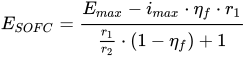
where:
This method acting was valid and plant to be suitable for optimization and sensitivity studies in plant-horizontal modelling of several systems with solid oxide fuel cells.[20] With this mathematical description it is possible to account for diametric properties of the SOFC. There are many parameters which impact cell working conditions, e.g. electrolyte material, electrolyte thickness, cell temperature, recess and outlet gas compositions at anode and cathode, and electrode porosity, just now to name roughly. The flux in these systems is often calculated using the Navier–Stokes equations.
Ohmic polarization [edit]
Ohmic losses in an SOFC result from ionic conductivity through the electrolyte and electrical resistance offered to the flow of electrons in the external circuit. This is inherently a materials property of the crystal structure and atoms mired. However, to maximize the ionic conductivity, several methods can be done. Firstly, operating at high temperatures can significantly decrease these ohmic losings. Substitutional doping methods to further refine the crystallization structure and restraint defect concentrations keister also gambol a significant role in increasing the conductivity. Another way to decrease ohmic resistance is to drop-off the thickness of the electrolyte layer.
Particle conductivity [cut]
An ionic specific electrical resistance of the electrolyte as a function of temperature can be described past the following relationship:[18]

where: – electrolyte thickness, and – ionic conductivity.


The particle conduction of the solidness oxide is defined as follows:[18]
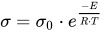
where: and – factors depended on electrolyte materials, – electrolyte temperature, and – abstract gas unvarying.


Concentration polarisation [edit]
The concentration polarization is the result of working limitations on mass transport within the cell and represents the voltage departure imputable spatial variations in reactant concentration at the chemically active sites. This situation can be caused when the reactants are consumed by the electrochemical reaction faster than they buttocks diffuse into the porous electrode, and can also embody caused by variation in bulk flow writing. The last mentioned is due to the fact that the consumption of reacting species in the reactant flows causes a drop by reactant concentration as it travels along the prison cell, which causes a drop in the localised electric potential near the tail end of the cubicle.
The assiduity polarisation occurs in both the anode and cathode. The anode can be particularly baffling, as the oxidation of the H produces steam, which further dilutes the fuel stream American Samoa it travels on the length of the cell. This polarization tush be mitigated by reducing the reactant utilization fraction or increasing the electrode porosity, but these approaches each have monumental project trade-offs.
Activation polarisation [edit]
The activation polarization is the result of the kinetics up to his neck with the electrochemical reactions. Each response has a certain activation barrier that must be overcome systematic to proceed and this barrier leads to the polarisation. The activation barrier is the result of many complex electrochemical reaction steps where typically the order limiting step is causative the polarisation. The polarization equation shown at a lower place is found by solving the Samuel Butler–Volmer equation in the high current density regime (where the cell typically operates), and can be used to estimate the activation polarisation:

where:
The polarisation nates be modified by microstructural optimization. The Triple Phase Limit (TPB) length, which is the length where poriferous, ionic and electronically conducting pathways all satisfy, straight relates to the electrochemically operational length in the cell. The larger the length, the more reactions rear end occur and thence the less the activation polarization. Optimization of TPB duration prat represent done by processing conditions to pretend microstructure or by materials selection to use a blended particle/electronic conductor to further increase TPB length.
Target [edit]
Department of Energy prey requirements are 40,000 hours of service for stationary fuel cell applications and greater than 5,000 hours for transportation systems (fuel cell vehicles) at a factory cost of $40/kilowatt for a 10 kW ember-based organization[21] without extra requirements. Lifetime effects (phase stability, thermal expansion compatibility, element migration, conductivity and ripening) must be self-addressed. The Solid Energy Conversion Alliance 2008 (interim) mark for overall degradation per 1,000 hours is 4.0%.[22]
Inquiry [edit]
Enquiry is loss now in the commission of lower-temperature SOFCs (600 °C). Low temperature systems can reduce costs away reducing insulation, materials, bulge out-up and degradation-related costs. With higher operating temperatures, the temperature gradient increases the austereness of thermal stresses, which affects materials cost and life of the system.[23] An grey temperature system (650-800 °C) would enable the use of cheaper metallic materials with amended mechanical properties and natural spring conductivity. Recent developments in nano-shell electrolyte structures have been shown to put down operative temperatures to around 350 °C, which would enable the use of even cheaper nerve and elastomeric/polymeric components.[24]
Lowering operating temperatures has the added welfare of exaggerated efficiency. Theoretical fuel cell efficiency increases with decreasing temperature. For instance, the efficiency of a SOFC victimisation CO as fuel increases from 63% to 81% when decreasing the system temperature from 900 °C to 350 °C.[24]
Research is also under way to improve the fuel flexibility of SOFCs. While unchangeable performance has been achieved connected a smorgasbord of hydrocarbon fuels, these cells typically rely on external fire processing. In the case of natural gas, the fuel is either outwardly or internally regenerate and the sulfur compounds are removed. These processes attention deficit disorder to the toll and complexity of SOFC systems. Exercise is under way at a number of institutions to improve the stability of anode materials for hydrocarbon oxidation and, therefore, relax the requirements for fuel processing and decrease SOFC balance of plant costs.
Enquiry is also going on in reducing start-up time to be able to put through SOFCs in mobile applications.[25] This give the axe be partly achieved by lowering operating temperatures, which is the case for proton exchange membrane fuel cells (PEMFCs).[26] Owing to their fuel flexibility, they may pass over on partially reformed Rudolf Christian Karl Diesel, and this makes SOFCs interesting as auxiliary power units (APU) in refrigerated trucks.
Specifically, Delphi Automotive Systems are developing an SOFC that will power auxiliary units in automobiles and tractor-trailers, while BMW has recently stopped a siamese project. A treble-temperature SOFC will generate all of the needed electrical energy to take into account the engine to be littler and many competent. The SOFC would go on the same gasolene or diesel as the engine and would keep the air conditioning unit and other necessary electrical systems run while the railway locomotive shuts off when not requisite (e.g., at a stop over ignite or truck stop).[ reference needed ]
Rolls-Royce is developing solid-oxide fuel cells produced by CRT screen printing onto inexpensive ceramic materials. Rolls-Royce Fuel Cell Systems Ltd is nonindustrial an SOFC gas turbine crossbred system fueled aside innate gas for power genesis applications in the order of a megawatt (e.g. Futuregen).[ quotation needed ]
3D printing is beingness explored as a possible manufacturing proficiency that could be used to make SOFC manufacturing easier by the Shah Lab at Northwestern University. This manufacturing technique would allow SOFC cell structure to be more flexible, which could lead to more cost-effective designs. This cognitive operation could work in the production of any part of the cell. The 3D printing process works by combining about 80% instrumentation particles with 20% binders and solvents, and then converting that slurry into an ink that prat be fed into a 3D printing machine. Some of the dissolver is identical volatile, so the ceramic ink solidifies almost immediately. Not all of the solvent evaporates, so the ink maintains some flexibility before it is unemployed at high temperature to densify it. This flexibility allows the cells to be fired in a circular shape that would gain the aboveground area over which electrochemical reactions can occur, which increases the efficiency of the mobile phone. Likewise, the 3D printing technique allows the cell layers to be printed on top of apiece separate or else of having to follow through separate manufacturing and stacking steps. The thickness is easy to control, and layers can be made in the exact size and shape that is needed, so waste is minimized.[27]
Ceres Power Ltd. has mature a scurvy cost and low temperature (500–600 degrees) SOFC plenty victimisation cerium gadolinium oxide (CGO) in place of current industry canonical instrumentation, yttria stabilised zirconium dioxide (YSZ), which allows the use of stainless to support the ceramic.[28]
Solid Cell Inc. has developed a uncomparable, low-cost cell architecture that combines properties of coplanar and vasiform designs, along with a Chromium-free cermet interconnect.
The high temperature electrochemistry gist (HITEC) at the University of FL, Gainesville is centered on poring over Ionic transport, electrocatalytic phenomena and microstructural enactment of ion conducting materials.[29]
SiEnergy Systems, a John Harvard byproduct company, has incontestable the first macro-scale thin-film semisolid-oxide fuel cell that can operate at 500 degrees.[30]
SOEC [cut]
A solid oxide electrolyser cell (SOEC) is a solid oxide fuel cell kick in regenerative mode for the electrolysis of water with a sound oxide, or ceramic, electrolyte to produce oxygen and hydrogen gas.[31]
SOECs can also represent used to do electrolysis of Carbon monoxide2 to farm CO and oxygen[32] operating room tied co-electrolysis of irrigate and CO2 to produce syngas and oxygen.
ITSOFC [edit]
SOFCs that operate in an intermediate temperature (IT) range, meaning between 600 and 800 °C, are named ITSOFCs. Because of the high degradation rates and materials costs incurred at temperatures in excess of 900 °C, information technology is economically much plausive to operate SOFCs at lower temperatures. The pushing for high-performance ITSOFCs is currently the topic of very much enquiry and development. One arena of focus is the cathode material. It is thought that the oxygen reduction reaction is responsible for much of the loss in performance so the catalytic activity of the cathode is being studied and enhanced through various techniques, including catalyst saturation. The research on NdCrO3 proves it to be a potential cathode material for the cathode of ITSOFC since it is thermochemically stable within the temperature range.[33]
Some other area of focus is electrolyte materials. To make SOFCs competitive in the market, ITSOFCs are pushing towards lower operational temperature by use of alternative new materials. Notwithstandin, efficiency and stability of the materials limit their feasibility. One prize for the electrolyte new materials is the ceria-salty ceramic composites (CSCs). The ii-phase CSC electrolytes GDC (Gd-doped ceria) and SDC (samaria-inebriated ceria)-MCO3 (M=Li, Na, K, single surgery salmagundi of carbonates) can hand the power tightness of 300-800 mW*cm−2.[34]
LT-SOFC [cut]
Bass-temperature solid oxide fire cells (LT-SOFCs), operating lower than 650 °C, are of great interest for future research because the high operative temperature is currently what restricts the development and deployment of SOFCs. A low-temperature SOFC is Sir Thomas More reliable imputable smaller thermal mismatch and easier sealing. Additionally, a lower temperature requires less insulation and therefore has a lower monetary value. Monetary value is further lowered due to wider material choices for interconnects and compressive nonglass/instrumentality seals. Perchance most importantly, at a turn down temperature, SOFCs can be started more chop-chop and with less vim, which lends itself to uses in portable and transportable applications.
As temperature decreases, the maximum supposed fuel cell efficiency increases, in dividing line to the Carnot cycle. For example, the maximum theoretical efficiency of an SOFC using CO as a fire increases from 63% at 900 °C to 81% at 350 °C.[35]
This is a materials put out, particularly for the electrolyte in the SOFC. YSZ is the most commonly used electrolyte because of its superior stability, despite non having the highest conductivity. Currently, the thickness of YSZ electrolytes is a minimum of ~10 μm receivable to deposit methods, and this requires a temperature higher up 700 °C. Therefore, low-temperature SOFCs are only possible with higher conduction electrolytes. Different alternatives that could be boffo at cold include gadolinium-doped ceria (GDC) and erbia-cation-stabilised bismuth (ERB). They have superior ionic conductivity at lower temperatures, but this comes at the expense of lower thermodynamic stability. CeO2 electrolytes become electronically conductive and Bi2O3 electrolytes decompose to metallic Bi low-level the reducing fuel environs.[36]
To scrap this, researchers created a functionally ranked ceria/bismuth-oxide bilayered electrolyte where the GDC layer connected the anode go with protects the ESB layer from decomposing while the ESB on the cathode side blocks the leak current direct the GDC layer. This leads to near-abstract open-circuit potential (OPC) with two highly conductive electrolytes, that by themselves would not have been sufficiently static for the application program. This bilayer tested to be stable for 1400 hours of examination at 500 °C and showed no indication of interfacial phase formation Beaver State thermal mismatch. While this makes strides towards lowering the operative temperature of SOFCs, it as wel opens doors for future research to try and understand this mechanism.[37]

Comparison of ionic conduction of various solid oxide electrolytes
Researchers at the Georgia Institute of Engineering dealt with the imbalance of BaCeO3 differently. They replaced a desired divide of Ce in BaCeO3 with Zirconium to fles a primary solid solution that exhibits proton conductivity, but also chemical and thermal stableness over the range of conditions pertinent to fuel cell operation. A new specific composition, Ba(Zr0.1Ce0.7Y0.2)O3-δ (BZCY7) that displays the highest ionic conductivity of wholly known electrolyte materials for SOFC applications. This electrolyte was fabricated by dry-pressing powders, which allowed for the production of crack free films thinner than 15 μm. The implementation of this acicular and cost-effective fabrication method acting may enable significant cost reductions in SOFC fabrication.[38] However, this electrolyte operates at high temperatures than the bilayered electrolyte model, closer to 600 °C kinda than 500 °C.
Presently, surrendered the res publica of the field for LT-SOFCs, progress in the electrolyte would reap the most benefits, but search into potential anode and cathode materials would also direct to useful results, and has started to be discussed more frequently in literature.
SOFC-GT [edit]
An SOFC-GT system is one which comprises a solid oxide fuel cell combined with a gas turbine. Much systems have been evaluated away Siemens Westinghouse and Rolls-Royce as a means to achieve high operating efficiencies by running the SOFC nether pressure. SOFC-GT systems typically include anodic and/Beaver State cathodic ambience recirculation, thus increasing efficiency.
In theory, the combination of the SOFC and gas turbine can turn over result in high overall (electric and thermal) efficiency.[39] Further combination of the SOFC-GT in a rolled into one cooling system, estrus and powerfulness (or trigeneration) conformation (via HVAC) too has the latent to yield even higher outpouring efficiencies in some cases.[40]
Another feature of the introduced hybrid system is connected the realise of 100% CO2 capturing at comparable high energy efficiency. These features care zero CO2 emission and high energy efficiency pull in the power engraft public presentation significant.[41]
DCFC [edit]
For the direct purpose of solid coal fire without additional gasification and reforming processes, a direct carbon fuel cell (DCFC) has been developed as a bright original concept of a high-temperature energy rebirth system. The underlying progress in the development of a coal-based DCFC has been categorized mainly according to the electrolyte materials used, such Eastern Samoa solid oxide, molten carbonate, and liquid hydrated oxide, besides as intercrossed systems consisting of solid oxide and molten carbonate binary electrolyte operating room of liquified anode (Fe, Silver, In, Sn, Sb, Pb, Atomic number 83, and its alloying and its metal/metal oxide) solid oxide electrolyte.[42] People's research connected DCFC with GDC-Li/Na2CO3 as the electrolyte, Sm0.5Sr0.5CoO3 as cathode shows virtuous performance. The highest power density of 48 mW*cm−2 seat be reached at 500 °C with O2 and CO2 as oxidant and the whole system is unchangeable inside the temperature range of 500 °C to 600 °C.[43]
SOFC operated along landfill gas
Every household produces devastate/refuse on a each day basis. In 2009, Americans produced around 243 million scads of municipal sound waste, which is 4.3 pounds of waste per person per day. All that waste is sent to landfill sites. Landfill gas which is produced from the decomposition of wastefulness that gets accumulated at the landfills has the potential drop to be a valuable source of push since methane is a John R. Major component. Currently, the bulk of the landfills either burn away their gas in flares or ignite it in mechanical engines to bring on electricity. The issue with automatic engines is that rudimentary combustion of gasses can lead to pollution of the atmosphere and is also highly inefficient.
The issue with using landfill gas to fuel an SOFC system is that landfill gas contains hydrogen sulphide. Some landfill accepting biological waste will stop about 50-60 ppm of atomic number 1 sulphide and around 1-2 ppm mercaptans. Nevertheless, construction materials containing reducible sulfur species, principally sulfates found in gypsum-based wallboard, can cause considerably higher levels of sulfides in the hundreds of ppm. At operational temperatures of 750 ⁰C H sulfide concentrations of around 0.05 ppm begin to affect the performance of the SOFCs.
Ni + H2S → NiS + H2
The above reaction controls the effect of sulfur on the anode.
This can be prevented by having screen backgroun hydrogen which is measured under.
At 453 K the equilibrium constant is 7.39 x 10⁻⁵
ΔG calculated at 453 K was 35.833 kJ/mol
Using the monetary standard heat of formation and entropy ΔG at room temperature (298 K) came out to be 45.904 kJ/mol
On extrapolation to 1023 K, ΔG is -1.229 kJ/mol
Along permutation, Keq at 1023 K is 1.44 x 10⁻⁴. Hence theoretically we need 3.4% hydrogen to prevent the geological formation of NiS at 5 ppm H2S.[44]
See also [edit]
- Auxiliary superpowe whole
- Blooming Energy Host – SOFC production from an American companion
- Ceramic Fuel Cells Ltd – Aussi company producing solid oxide fuel cells
- Glossary of fuel cell price
- Hydrogen technologies
- Micro combined heat and power
References [edit]
- ^ Badwal, SPS. "Revaluation of Progress in Hotness Solid Oxide Fire Cells". Journal of the Aboriginal Australian Ceramics Society. 50 (1). Archived from the innovative on 29 November 2014.
- ^ Instrumentation fuel cells achieves world-best 60% efficiency for its electricity generator units Archived 3 June 2014 at the Wayback Motorcar. Ceramic Fuel Cells Limited. 19 February 2009
- ^ a b Electrical energy from wood through and through the combination of gasification and solid oxide fire cells, Ph.D. Thesis by Florian Nagel, Swiss Federal Institute of Applied science Zurich, 2008
- ^ Sammes, N.M.; et al. (2005). "Intention and fabrication of a 100 W anode supported little-cannular SOFC smokestack". Daybook of Might Sources. 145 (2): 428–434. Bibcode:2005JPS...145..428S. doi:10.1016/j.jpowsour.2005.01.079.
- ^ Panthi, D.; et al. (2014). "Micro-tubular solid oxide fuel cell supported a porose yttria-stabilized zirconia support". Scientific Reports. 4: 5754. Bibcode:2014NatSR...4E5754P. Interior Department:10.1038/srep05754. PMC4148670. PMID 25169166.
- ^ Ott, J; Gan, Y; McMeeking, R; Kamlah, M (2013). "A micromechanical model for hard-hitting conductivity in granular electrode structures" (PDF). Acta Mechanica Sinica. 29 (5): 682–698. Bibcode:2013AcMSn..29..682O. doi:10.1007/s10409-013-0070-x. S2CID 51915676.
- ^ Zhu, Tenglong; Fowler, Daniel E.; Poeppelmeier, Kenneth R.; Han, Minfang; Barnett, Robert Scott A. (2016). "Atomic number 1 Oxidation Mechanisms on Perovskite Solid Oxide Fire Cell Anodes". Journal of the Electrochemical Society. 163 (8): F952–F961. doi:10.1149/2.1321608jes.
- ^ Bao, Zhenghong; Yu, Fei (1 January 2022), Atomic number 3, Yebo; Ge, Xumeng (eds.), "Chapter Two - Catalytic Conversion of Biogas to Syngas via Unsweet Reforming Process", Advances in Bioenergy, Elsevier, 3, pp. 43–76, retrieved 14 November 2022
- ^ Rostrup-Nielsen, J. R. (1982). Figueiredo, José Luís (erectile dysfunction.). "Sulfur Toxic condition". Forward motion in Accelerator Deactivation. NATO Advanced Take Institutes Serial publication. Dordrecht: Springer Netherlands: 209–227. doi:10.1007/978-94-009-7597-2_11. ISBN978-94-009-7597-2.
- ^ Sasaki, K.; Susuki, K. (2006). "H2S Toxic condition of Solid Oxide Fire Cells". Daybook of the Chemical science Society. 153 (11): 11. Bibcode:2006JElS..153A2023S. doi:10.1149/1.2336075.
- ^ a b Ge, Xiao-Ming; Chan, Siew-Hwa; Liu, Qing-Lin; Sun, Qiang (2012). "Sound Oxide Fuel Jail cell Anode Materials for Direct Hydrocarbon Utilization". Advanced Department of Energy Materials. 2 (10): 1156–1181. Department of the Interior:10.1002/aenm.201200342. ISSN 1614-6840.
- ^ Rib-Nunes, Olga; Gorte, Raymond J.; Vohs, John M. (1 March 2005). "Comparison of the performance of Cu–CeO2–YSZ and Ni–YSZ complex SOFC anodes with H2, CO, and syngas". Diary of Power Sources. 141 (2): 241–249. Bibcode:2005JPS...141..241C. Interior:10.1016/j.jpowsour.2004.09.022. ISSN 0378-7753.
- ^ Nigel Sammes; Alevtina Smirnova; Oleksandr Vasylyev (2005). "Fuel Cell Technologies: State and Perspectives". NATO Scientific discipline Series, Mathematics, Physics and Chemistry. 202: 19–34. Bibcode:2005fcts.conf.....S. doi:10.1007/1-4020-3498-9_3.
- ^ Steele, Before ChristH., Heinzel, A. (2001). "Materials for fire-cell technologies". Nature. 414 (15 November): 345–352. Bibcode:2001Natur.414..345S. doi:10.1038/35104620. PMID 11713541. S2CID 4405856. CS1 maint: doubled names: authors list (link)
- ^ Mohan Menon; Kent Kammer; et al. (2007). "Processing of Ce1-xGdxO2-δ (GDC) thin films from precursors for application in solid oxide fuel cells". Advanced Materials Engineering. 15–17: 293–298. doi:10.4028/World Wide Web.scientific.net/AMR.15-17.293. S2CID 98044813.
- ^ Charpentier, P (2000). "Homework of thin film SOFCs working at reduced temperature". Solid State Department Ionics. 135 (1–4): 373–380. doi:10.1016/S0167-2738(00)00472-0. ISSN 0167-2738.
- ^ Hai-Bo Huo; Xin-Jian Zhu; Guang-Yi Cao (2006). "Nonlinear modeling of a SOFC heap based on a to the lowest degree squares support transmitter machine". Journal of Power Sources. 162 (2): 1220–1225. Bibcode:2006JPS...162.1220H. doi:10.1016/j.jpowsour.2006.07.031.
- ^ a b c d Milewski J, Miller A (2006). "Influences of the Type and Heaviness of Electrolyte on Solid Oxide Fuel Cell Hybrid Scheme Performance". Journal of Fuel Cell Science and Technology. 3 (4): 396–402. Interior:10.1115/1.2349519.
- ^ M. Santarelli; P. Leone; M. Calì; G. Orsello (2007). "Experimental evaluation of the sensitivity to fire utilization and melodic line management along a 100 kW SOFC arrangement". Diary of Business leader Sources. 171 (2): 155–168. Bibcode:2007JPS...171..155S. Department of the Interior:10.1016/j.jpowsour.2006.12.032.
- ^ Kupecki J.; Milewski J.; Jewulski J. (2013). "Investigation of SOFC material properties for plant life-level modeling". Central European Diary of Chemistry. 11 (5): 664–671. DoI:10.2478/s11532-013-0211-x.
- ^ SECA Coal-Based Systems – LGFCS. www.osti.gov. Retrieved 19 February 2022.
- ^ Fuel Cell Stacks Still Going Strong After 5,000 Hours. WWW.energy.gov (24 March 2009). Retrieved 27 November 2011. Archived 8 October 2009 at the Wayback Auto
- ^ Ishihara, Tatsumi (2009). Perovskite Oxide for Solid Oxide Fuel Cells . Springer. p. 19. ISBN978-0-387-77708-5.
- ^ a b Wachsman, Eric; Lee Yuen Kam, Kang (18 November 2011). "Lowering the Temperature of Solid Oxide Fire Cells". Science. 334 (6058): 935–9. Bibcode:2011Sci...334..935W. doi:10.1126/science.1204090. PMID 22096189. S2CID 206533328.
- ^ Spivey, B. (2012). "Dynamic modeling, simulation, and MIMO prophetical control of a tubular solid oxide fuel cell". Journal of Process Control. 22 (8): 1502–1520. Department of the Interior:10.1016/j.jprocont.2012.01.015.
- ^ "Fire Cell Comparison". Nedstack. Nedstack. Retrieved 6 Nov 2022.
- ^ "Northwesterly grouping invent inks to make SOFCs by 3D printing". Fuel Cells Bulletin. 2015: 11. 2022. Interior Department:10.1016/S1464-2859(15)70024-6.
- ^ "The Ceres Cell". Troupe Internet site. Ceres Power. Archived from the original along 13 Dec 2013. Retrieved 30 November 2009.
- ^ "HITEC". Hitec.mse.ufl.edu. Archived from the original on 12 Dec 2013. Retrieved 8 December 2013.
- ^ Chilling Down Solid-Oxide Fuel Cells. Technologyreview.com. 20 Apr 2011. Retrieved 27 November 2011.
- ^ Anne Hauch; Søren Højgaard Jensen; Sune Dalgaard Ebbesen; Mogens Mogensen (2009). "Durability of solid oxide electrolysis cells for H production" (PDF). Risoe Reports. 1608: 327–338. Archived from the original (PDF) on 11 July 2009.
- ^ Rainer Küngas; Peter Blennow; Dylan Marlais Thomas Heiredal-Clausen; Tobias Holt; Jeppe Rass-Hansen; Søren Primdahl; Whoremaster Bøgild Hansen (2017). "eCOs - A Commercial CO2 Electrolysis Arrangement Highly-developed by Haldor Topsoe". ECS Trans. 78 (1): 2879–2884. Bibcode:2017ECSTr..78a2879K. doi:10.1149/07801.2879ecst.
- ^ Nithya, M., and M. Rajasekhar. "Preparation and Characterization of NdCrO3 Cathode for Intermediate Temperature Fuel Cell Application." International Daybook of Practical Alchemy 13, no. 4 (2017): 879-886.
- ^ Zhu, Binful (2003). "Functional ceria–salt-composite plant materials for advanced ITSOFC applications". Journal of Power Sources. 114 (1): 1–9. Bibcode:2003JPS...114....1Z. doi:10.1016/s0378-7753(02)00592-x.
- ^ Choi, S.; Yoo, S.; Park, S.; Jun, A.; Sengodan, S.; Kim, J.; Shin, J. Highly efficient and robust cathode materials for low-temperature three-dimensional oxide fire cells: PrBa0.5Sr0.5Co(2-x)Fe(x)O(5+δ). Sci. Repp. 2013, 3, 2426-2428.
- ^ Hibini, T.; Hashimoto, A.; Inoue, T.; Tokuno, J.; Yoshida, S.; Sano, M. A Low-Operating-Temperature Solid Oxide Fuel Cell in Hydrocarbon-Ventilate Mixtures. Science. 2000. 288, 2031-2033.
- ^ Wachsman, E.; Lee, Kang T. (2011). "Heavy the Temperature of Solid Oxide Fuel Cells". Science. 334 (6058): 935–939. Bibcode:2011Sci...334..935W. doi:10.1126/science.1204090. PMID 22096189. S2CID 206533328.
- ^ Zuo, C.; Zha, S.; Liu, M.; Hatano, M.; Uchiyama, M. Ba(Zr0.1Ce0.7Y0.2)O3-δ as an Electrolyte for Low-Temperature Solid-Oxide Fire Cells. Advanced Materials. 2006, 18, 3318-3320
- ^ S.H. Chan; H.K. Ho; Y. Tian (2003). "Multi-level clay sculpture of SOFC-gas turbine hybrid organization". International Journal of H Energy. 28 (8): 889–900. doi:10.1016/S0360-3199(02)00160-X.
- ^ L. K. C. Tse; S. Wilkins; N. McGlashan; B. Urban; R. Martinez-Botas (2011). "Solid oxide fuel cell/gas turbine trigeneration system for marine applications". Journal of Power Sources. 196 (6): 3149–3162. Bibcode:2011JPS...196.3149T. doi:10.1016/j.jpowsour.2010.11.099.
- ^ Isfahani, SNR; Sedaghat, Ahmad (15 June 2022). "A hybrid micro gas turbine and worthy state fuel cell power plant with hydrogen output and CO2 capture". Worldwide Journal of H Energy. 41 (22): 9490–9499. Department of the Interior:10.1016/j.ijhydene.2016.04.065.
- ^ Giddey, S; Badwal, SPS; Kulkarni, A; Munnings, C (2012). "A extensive review of point-blank carbon fuel cell technology". Progress in DOE and Combustion Science. 38 (3): 360–399. doi:10.1016/j.pectoral muscle.2012.01.003.
- ^ Wu dialect, Wei; Ding, Dong; Lover, Maohong; Atomic number 2, Ting (30 May 2022). "A High Performance Frigidnes Direct Carbon Fuel Prison cell". ECS Minutes. 78 (1): 2519–2526. Bibcode:2017ECSTr..78a2519W. doi:10.1149/07801.2519ecst. ISSN 1938-6737. OSTI 1414432.
- ^ Caravan inn, Feroze (1 January 2012). Effect of Hydrogen Sulfide in Landfill Flatulency on Anode Poisoning of Solid Oxide Fuel Cells (Dissertation). Youngstown State University.
Foreign links [redact]
- US Department of Energy page on SOFCs
- National Energy Applied science Science laborator web site on SOFCs
- An clause in Cyclopaedia at YCES
- Illinois Institute of Engineering science page on SOFCs
- Assessment of Solid Oxide Fuel Cells in Building Applications Phase angle 1: Clay sculpture and Preliminary Analyses
- CSA Overview of SOFCs
- SOFC ice-instrumentality sealing
- Refractory Specialties Inc.
- Materials &ere; Systems Explore, Inc.'s (MSRI)
- Solid Oxide Fire Cubicle (SOFC) Grocery store
- Solid Oxide Fire Cells Canada (SOFCC) Strategic Inquiry Net
- SOFC Dynamics and Keep in line Research
- Solid State Energy Conversion Bond (SECA)
- SOFC Production Equipment
Source: https://en.wikipedia.org/wiki/Solid_oxide_fuel_cell


0 Komentar
Post a Comment